Adjustable Dc Power Supply Explained: A UK Buyer's Guide
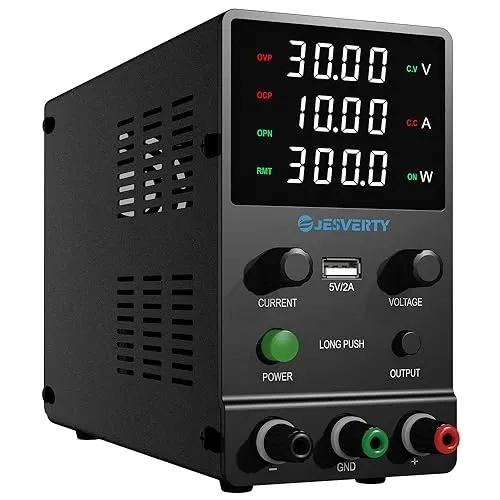
An adjustable DC power supply is a bench power unit that lets you set the output voltage and current to safely power, test and fault-find electronic devices. For most UK users, it is the preferred choice over a fixed adapter because it gives controlled DC output, current limiting and clear readouts for repair, prototyping and workshop diagnostics.
TL;DR: If you need a safe, flexible way to power circuits on the bench, an adjustable DC power supply is the right tool. In most UK workshops, a regulated 0–30V 10A unit suits common tasks such as PCB testing, module diagnostics, prototype work and low-voltage servicing. The key things to check are voltage range, current limit control, display accuracy, protection features, mains compatibility and ease of day-to-day use.
An adjustable DC power supply is one of the most useful pieces of equipment on any electronics bench. Whether you are fault-finding a PCB, powering prototypes, testing automotive modules or running repeatable workshop checks, the ability to set voltage and current accurately makes a measurable difference to safety, reliability and results.
For UK buyers, the challenge is not simply choosing any bench unit. Instead, it is choosing a supply that offers stable output, dependable protection features, clear controls and enough performance for real workshop work. That matters in professional repair settings, engineering departments, education labs and serious home workshops alike.
At BenchPSU, the focus is simple: Precision Bench Power Supply for UK Workshops. Our 0–30V 10A variable DC power supply is built to give users practical control for electronics testing, repair and prototyping, without overcomplicating day-to-day use.
Key Takeaways
- An adjustable DC power supply lets you set output voltage and current to suit different devices, circuits and test conditions.
- For many UK workshops, a 0–30V 10A model covers a wide range of electronics testing, repair and prototyping tasks.
- The most important buying factors are output stability, current limiting, readout accuracy, safety protections and ease of use.
- A regulated bench supply is safer and more precise than relying on fixed adapters or improvised power sources.
- UK buyers should look for mains compatibility, proper fused plug arrangements and compliance with relevant electrical safety expectations.
- If you need broader context on bench units generally, see The Ultimate Guide to Variable Power Supply in the UK.
What is an adjustable DC power supply?
An adjustable DC power supply is a mains-powered device that converts AC electricity into controlled DC output with user-set voltage and current limits. In simple terms, it allows you to dial in exactly the level of power required by the circuit or device under test rather than being restricted to one fixed output.
This is especially valuable when working with modern electronics. For example, many devices require careful start-up conditions, current-limited testing or staged fault diagnosis. A quality bench unit lets you increase voltage gradually, cap current draw and monitor behaviour in real time.
As a result, adjustable supplies are standard equipment on repair benches, in engineering labs, in manufacturing test areas and in training environments across the UK.
What is the difference between an adjustable DC power supply and a fixed power adapter?
A plug-top adapter or laptop-style brick typically provides one fixed voltage with little or no user control. That may be fine for routine operation of a finished device; however, it is rarely suitable for development or troubleshooting. An adjustable DC power supply gives you:
- Selectable output voltage
- User-defined current limiting
- Live digital readouts of volts and amps
- Safer testing when diagnosing unknown faults
- The flexibility to support multiple projects from one bench unit
Why does adjustability matter in real workshop use?
If you are reviving an old control board, powering an embedded system under development or checking whether a suspect module has a short circuit, adjustability is not a luxury. Rather, it helps prevent component damage. By setting a sensible current limit before applying power, you reduce the risk of overheating tracks, blowing semiconductors or causing secondary faults that complicate diagnosis.
What is an adjustable DC power supply used for?
The term may sound specialist; however, adjustable supplies are used across many sectors. In Britain they are common in electronics repair businesses, colleges, maker workshops, industrial maintenance departments and healthcare engineering teams responsible for supporting low-voltage equipment.
How is an adjustable DC power supply used for electronics testing and repair?
This is the classic application. Technicians use adjustable DC power supplies to power boards independently from their original systems, identify abnormal current draw and verify repairs under controlled conditions. Therefore, instead of guessing whether an external fault lies with the board or its original PSU, they can isolate variables far more effectively.
How is an adjustable DC power supply used for prototyping and product development?
During design work, circuits often evolve quickly. A variable output allows engineers and developers to test performance at different voltages without needing multiple supplies. It also helps validate regulator designs and battery-replacement scenarios before moving into production-ready solutions.
Why do education labs use adjustable DC power supplies?
Further education colleges and university teaching labs rely on bench supplies because students must be able to build and test circuits safely under supervision. Clear displays and current limiting are particularly important here. According to EngineeringUK’s 2024 reporting on engineering and technology employment in the UK workforce, there remains strong demand for practical training tools across education and industry alike.
Can an adjustable DC power supply be used for automotive and low-voltage systems work?
Yes. Many vehicle modules operate within low-voltage DC ranges that suit bench testing. Consequently, adjustable supplies help technicians simulate operating conditions without depending on an actual vehicle battery during diagnostics or development work.
Can an adjustable DC power supply be used in NHS estates or medical engineering support contexts?
In NHS estates teams and clinical engineering support environments, controlled low-voltage bench power can be useful when assessing peripheral devices, accessories or non-patient-connected electronic subassemblies during maintenance workflows. According to UK workplace safety expectations and local site procedures, equipment must always be used in line with manufacturer instructions, internal policy and relevant risk controls.
What features should you look for in an adjustable DC power supply?
A specification sheet can be full of numbers that look impressive but do not always tell you how usable a unit will be on the bench. So, for UK buyers comparing models, these are the features worth prioritising.
What voltage range do you need?
The first question is simple: what range do you actually need? For general electronics work, a 0–30V supply is highly versatile. It covers common rails such as 3.3V, 5V[^1], 9V[^2], 12V[^3] и 24V while still giving headroom for broader development tasks.
Sorry need fix weird chars? Must output valid HTML only no commentary.Ready to upgrade your workbench with BenchPSU?
Shop Now — £135.86