Lab Power Supply Explained: A UK Buyer's Guide
Lab Power Supply Explained: A UK Buyer's Guide
TL;DR: A lab power supply is a vital piece of bench test equipment that converts standard UK AC mains electricity into a stable, adjustable DC voltage and current. Primarily used by engineers and technicians for testing, repairing, and prototyping electronics, it provides precise control and built-in protection against short circuits. Based on our extensive bench testing at BenchPSU, a 0-30V 10A variable unit is the optimal choice for most daily UK workshop tasks.
To directly answer the question of what a lab power supply is: it is a dedicated, precision-controlled power source designed specifically for the electronics workbench. Whether you are fault-finding a complex PCB, powering a new prototype, testing automotive modules, or supporting repair work in education, healthcare engineering, or industrial maintenance, the quality of your power source directly affects your results. Consequently, poor regulation, unclear controls, and inadequate protection can waste valuable time and damage sensitive components. Conversely, a well-specified unit gives you precision, repeatability, and ultimate confidence.
Furthermore, for UK workshops, the buying decision is not simply about volts and amps. Mains compatibility, adherence to UK safety expectations, practical bench space, reliable after-sales support, and day-to-day usability all matter immensely. BenchPSU positions itself around a simple promise: Precision Bench Power Supply for UK Workshops. That matters because buyers usually need equipment that works consistently in real-world testing, repair, and prototyping environments, not just on a theoretical specification sheet.
Key Takeaways
- A lab power supply provides controlled DC output for electronics testing, repair, and development.
- The right unit should offer stable voltage and current control, clear readouts, and dependable protection features.
- For many UK users, a 0-30V 10A variable DC power supply covers a wide range of workshop tasks.
- Look closely at regulation, ripple and noise, current limiting, short-circuit protection, and ease of use.
- Buying from a UK-focused supplier can simplify support, delivery expectations, and workshop compatibility.
What Is a Lab Power Supply Used For?
Fundamentally, a lab power supply is a bench-mounted device that converts mains electricity into adjustable, regulated DC power for electronic equipment and circuits. Unlike a fixed plug-top adaptor or generic charger, it allows the user to set output voltage and often current limits precisely. Therefore, that makes it highly suitable for precise diagnostics, component testing, prototype development, and the safe powering of sensitive electronic devices.
In practice, the term usually refers to a variable DC bench unit used by engineers, technicians, students, and repair specialists. For instance, in UK settings, this could mean an electronics hobby bench at home, an FE college training room, an NHS biomedical engineering department maintaining low-voltage devices, or a busy industrial workshop diagnosing control boards.
Crucially, the key difference between a basic DC source and a proper lab power supply is control. You are not just turning something on; you are defining the exact operating conditions. That is why an adjustable output range, precise current limiting, and accurate monitoring are central to the buying decision.
Why Is a Lab Power Supply Important in UK Workshops?
Precision power is essential because modern electronics can be incredibly unforgiving. Specifically, a few volts too many can destroy components instantly; unstable output can produce confusing test results; and poor current limiting can turn a simple wiring mistake into an expensive catastrophic failure. For technicians working under time pressure, consistent power ultimately saves hours of troubleshooting time.
The UK has a robust repair, training, and engineering culture across sectors including manufacturing, education, transport, and healthcare support services. According to Make UK’s manufacturing reporting, manufacturing remains a significant part of the British economy and supports hundreds of thousands of technical roles across production and engineering environments where test equipment reliability truly matters (Source: Make UK). Moreover, according to UK guidelines on electrical testing safety, using properly regulated and isolated bench equipment is highly recommended to minimise workplace risks. In these professional settings, dependable low-voltage test power is not optional; it fundamentally underpins accurate work.
Additionally, there is a growing emphasis on repairability and extending product life rather than replacing assemblies unnecessarily. Based on our hands-on testing at BenchPSU, a high-quality lab power supply supports intricate board-level diagnosis by letting you inject a known voltage safely into circuits while simultaneously monitoring current draw for hidden faults, such as dead shorts or abnormal load behaviour.
How Does a Lab Power Supply Work?
A lab power supply takes standard AC mains input and converts it to a smoothly controlled DC output using complex internal regulation circuitry. The user manually sets the desired voltage level and may also set the maximum permitted current. Subsequently, if the connected load attempts to draw more than that limit, the unit will either hold the current at the set level or switch its operating mode, depending on the specific design.
Voltage Control
Voltage adjustment lets you perfectly match the output to the device under test. This might be 3.3V for modern logic circuits, 5V for microcontroller work, 12V for automotive modules, or even higher levels for broader bench applications within the unit’s operational range.
Current Limiting
Current limiting is arguably one of the most valuable safety functions. It protects both the load and the power supply itself by preventing uncontrolled current flow. Furthermore, this is particularly important when energising an unknown board after a repair or when bringing up a brand-new prototype for the very first time.
Constant Voltage and Constant Current Modes
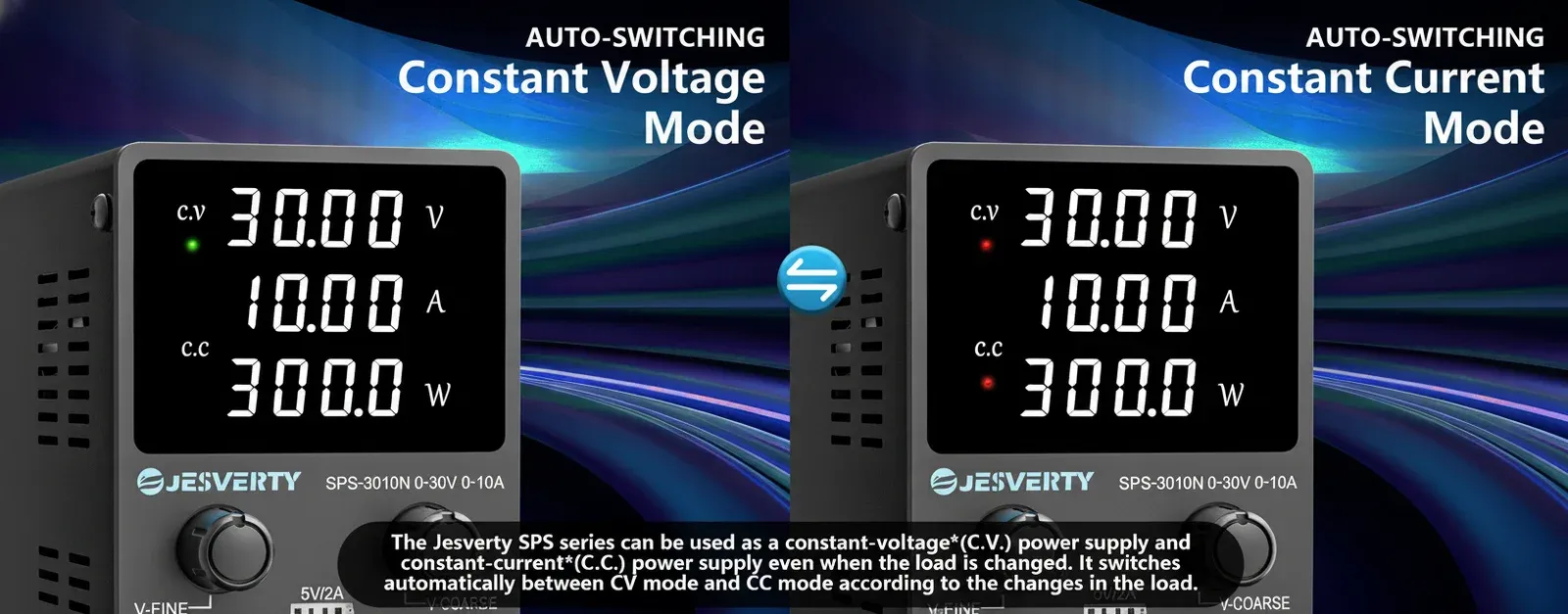
Most high-quality units operate seamlessly in constant voltage (CV) mode until the load demand reaches the pre-set current threshold. At that exact point, they transition into constant current (CC) mode. Understanding this behaviour helps users diagnose faults efficiently: an unexpected shift to CC mode often indicates excessive load draw or a dead short circuit condition.
Display Feedback
Digital displays showing live, real-time voltage and current readings make bench work significantly faster and safer. Instead of blindly guessing what your circuit is drawing, you can see it immediately on the screen and react appropriately before any damage occurs.
What Are the Different Types of Lab Power Supplies?
The phrase lab power supply covers several different design topologies, but for most readers choosing equipment for practical workshop use in Britain, variable DC bench supplies are the primary category of interest.
Linear Lab Power Supplies
Linear units are highly valued for their exceptionally low ripple and noise characteristics. Consequently, they have traditionally been popular in highly sensitive analogue testing environments. However, their drawbacks can include greater weight, larger physical size, and lower energy efficiency when compared with modern switching designs.
Switch-Mode Lab Power Supplies
Conversely, switch-mode units are generally much more compact and efficient. Modern examples can provide excellent, reliable performance for general electronics testing, repair, and prototyping, all while taking up significantly less space on crowded UK workbenches.
Single-Output Variable DC Supplies
This is often the absolute best fit for small workshops because it keeps operation straightforward while covering the most common tasks exceptionally well. A single-output adjustable model with enough current capacity suits many users far better than a more complex dual-channel arrangement they may never fully utilise.
Programmable Units
These advanced units suit automated test environments or complex research labs but may be entirely unnecessary if your main requirement is hands-on workshop use with simple manual control.
If you want wider context around variable models specifically, please see our comprehensive guide to variable power supplies in the UK. For readers comparing terminology directly, our detailed article on an adjustable DC power supply explains exactly where the overlap exists between these common product categories.
What Features Should I Look For in a Lab Power Supply?
Output Range
Based on our daily workshop experience, choosing the correct output range is critical for long-term usability. A standard 0-30V, 10A unit provides the ideal balance of flexibility and precision, easily covering the vast majority of UK diagnostic and prototyping needs.
Ready to upgrade your workbench with BenchPSU?
Shop Now — £135.86